
Codename Pirx (package
pirx). Lem's pilot is trusted with a ship because he treats his own judgement as fallible and checks it against the instruments. This document is the instrument panel.
Document:  docs/MANUAL.md, version 2.4 (2.4: a grant file is input,
           0.7.6.0; 2.3: the gate's ledger trail drawn as two processes,
           0.7.5.1; 2.2: the grant clock, 0.7.5.0)
Audience:  the operator - the person who runs Pirx, answers its prompts, and
           is asked afterwards what happened. Assumes competence, not
           familiarity
Companion: README (what Pirx is and is not), ARCHITECTURE (how it is built),
           THREAT-MODEL (what it defends against and what it does not)
Note:      every constant, event name, and exit code here was read out of the
           code, not recalled. Where a claim is weaker than it sounds, this
           document says so rather than rounding up
Contents
- What Pirx does
- Install
- Choosing a topology
- The gate
- The runner
- The approval prompt
- Key management
- The ledger
- Directory lifecycle and pruning
- Recovery procedures
- Monitoring and alerting
- Reference: constants
- Reference: ledger events
- Reference: refusals
- Reference: exit codes and environment
- Troubleshooting
- What Pirx will not do
- Glossary
1. What Pirx does
Pirx holds a high-impact action until a human has approved the exact bytes that describe it, then hands over authority bound to the SHA-256 of those bytes: valid once, expiring shortly, spendable on nothing else.
The sentence that matters most is the one about bytes. Most human-in-the-loop systems show a person a summary and record a boolean. Pirx shows the canonical byte sequence, hashes those same bytes, and binds the resulting grant to that hash. What was approved and what executes cannot drift apart, because they are the same object.
Two things can put an action in front of that approval:
| Entry point | The action comes from | You run |
|---|---|---|
| The gate | An MCP tools/ sent by an agent |
pirx-gate + pirx gate-approve |
| The runner | A ranked CVE verdict from cve-digest | pirx run |
After the action exists, both paths are identical: render, challenge, decide, issue, spend, execute, record.
2. Install
Python 3.14 or newer. The runtime has no third-party dependencies. The Jira
adapter uses urllib; the gate uses subprocess and json. Nothing in the
write path has a supply chain to audit.
git clone https://github.com/jerzy99jerzy/pirx.git
cd pirx
python3 -m venv .venv && source .venv/bin/activate
pip install -e .
Two commands land on your PATH:
which pirx pirx-gate
Verify by running pirx with no arguments. It prints usage and exits 64.
There is no --version doctor command: a self-test that passes tells you less
than a run that stops honestly, and section 5 gives you one of those in thirty
seconds.
2.1 Virtual environments, and why you want two
If you are gating a downstream MCP server, that server almost certainly has dependencies. Keep it in its own environment and point the gate at its interpreter by absolute path:
python3 -m venv ~/mcp-lab && ~/mcp-lab/bin/pip install "mcp>=2"
pirx-gate ~/pirx-gate -- ~/mcp-lab/bin/python /path/to/server.py
Pirx stays stdlib-only in its runtime. Installing a server's dependencies into Pirx's environment quietly gives that property away, and nothing will warn you.
3. Choosing a topology
Pirx runs in one of two shapes, and which one you are in is decided by whether a grant key file exists - not by a flag. A flag that selects a security property is a security property that gets selected wrongly at 02:00.
3.1 Single process (the runner)

Mermaid source
flowchart LR
    P["pirx run"] --> R["propose"] --> A(["approve<br/><i>same process</i>"])
    A --> S["spend"] --> E["execute"]
    classDef default fill:#161b22,stroke:#7d8590,color:#e6edf3
    classDef human fill:#2b1f3a,stroke:#ffb86c,color:#ffd9a8,stroke-width:3px
    class A human
With PIRX_ unset, pirx run generates an ephemeral key in
memory. Grants are meaningless outside that process, which is the property the
project had by construction for its first six versions. Nothing to manage, no
key to lose.
3.2 Two processes (the gate)

Mermaid source
flowchart LR
    AH["agent host"] -->|"tools/call"| G["pirx-gate"]
    G -->|"only once a grant<br/>covers these bytes"| D["downstream<br/>MCP server"]
    G -->|"writes"| PEND[("pending/")]
    PEND --> AP["pirx gate-approve"]
    AP --> H(["human<br/><i>a terminal the gate<br/>does not own</i>"])
    H -->|"issues"| GR[("grants/")]
    GR -->|"read on the next retry"| G
    classDef default fill:#161b22,stroke:#7d8590,color:#e6edf3
    classDef human fill:#2b1f3a,stroke:#ffb86c,color:#ffd9a8,stroke-width:3px
    classDef store fill:#26233a,stroke:#9ccfd8,color:#e0def4
    class H human
    class PEND,GR store
The gate cannot host its own approval prompt: its stdin and stdout are the JSON-RPC pipes, and an approval routed back through the protocol would render inside the trust domain of the agent whose call is being reviewed. So the human sits at a second process, and grants must verify across the boundary. That requires a shared key, and the gate refuses to start without one.
Two consequences of the split, stated because they are costs:
- Grant expiry runs on the wall clock. From 0.7.0.0 through 0.7.4.0 this
line said so and the code ran on the monotonic clock (F60, fixed in
0.7.5.0). A monotonic deadline cannot be evaluated by another process, and
it restarts at boot and stops while the host sleeps, each of which let a
grant outlive its five minutes. The wall clock can be moved backwards
instead, so a spend whose clock reads earlier than the grant's issue time
is refused (
refusal.grant_): one backward step extends a grant by less than five minutes. Repeated steps are an accepted residual (PT21), and authenticated time sync on the gate host is your control, not Pirx's.not_ yet_ valid - A grant is a file, and therefore copyable. The MAC makes forgery hard; the durable spend store makes a copy useless; nothing makes the file secret, and no part of the design assumes it is.
4. The gate
4.1 Set up a gate directory
mkdir -p ~/pirx-gate
python3 -c "import secrets, pathlib; pathlib.Path('$HOME/pirx-gate/key').write_bytes(secrets.token_bytes(32))"
chmod 600 ~/pirx-gate/key
export PIRX_GRANT_KEY_FILE=$HOME/pirx-gate/key
The directory fills with five things:
~/pirx-gate/
  key            the shared HMAC key (yours to protect; see section 7)
  ledger.jsonl   the hash-chained record of everything that happened
  pending/       proposals rendered and waiting for a human
  grants/        issued grants, waiting to be spent, named by action hash
  spent/         one empty file per burnt nonce - the durable single-use record
4.2 Run it
pirx-gate ~/pirx-gate -- ~/mcp-lab/bin/python /path/to/downstream_server.py
Everything after -- is the downstream server's command, exactly as you would
have typed it. It is the only command the gate will ever spawn. Nothing
from a payload, a tool definition, or a model can reach that argv; a structural
test asserts exactly one Popen, taking its command from the stored
constructor argument, never through a shell.
In an agent host's configuration file:
{
  "mcpServers": {
    "gated-repo": {
      "command": "/Users/you/pirx/.venv/bin/pirx-gate",
      "args": ["/Users/you/pirx-gate", "--",
               "/Users/you/mcp-lab/bin/python", "/path/to/server.py"],
      "env": { "PIRX_GRANT_KEY_FILE": "/Users/you/pirx-gate/key" }
    }
  }
}
Use absolute paths for everything. An agent host does not inherit your shell.
4.3 The first run gates nothing
The gated registry ships empty, exactly as the capability registry did in 0.1.0.0: the machinery runs and guards nothing until you register a tool.
This is the intended first experience. Send a few calls, watch the ledger fill
with gate.forwarded_, and satisfy yourself that the plumbing works
before you make anything refuse. A gate that refuses on day one teaches you
nothing about whether it is wired correctly.
4.4 Register a tool to be gated
A code change, reviewed like one. There is no runtime path that adds a gated tool, and there will not be.
Step 1 - get the definition hash of the tool as your downstream server
currently publishes it. Take the definition from the server's tools/
output; do not retype it from documentation.
from pirx.mcp.protocol import tool_definition_hash

definition = {
    "name": "repo.write_file",
    "description": "Write a file",
    "inputSchema": {"type": "object", "properties": {"path": {"type": "string"}}},
}
print(tool_definition_hash(definition))
Step 2 - add the entry in pirx/:
PRODUCTION_GATED_REGISTRY = GatedRegistry((
    GatedTool(tool="repo.write_file", definition_hash="e139b922..."),
))
Step 3 - review the diff as you would review a capability. You are recording that you read this tool's definition and consider calls to it worth a human's attention.
Why the hash is pinned. If the downstream server later changes that tool's
definition - a widened schema, a rewritten description that instructs a model
differently - the gate refuses with refusal.tool_ instead of
silently gating a tool that is no longer the one you reviewed. Re-pinning is a
deliberate act, and that is exactly the review moment a rug-pull needs to hit.
The hash is also inside the action hash, so even without the check a grant approved under one definition cannot be spent against a proposal built under another.
4.5 What the caller sees while waiting
{"result": {"resultType": "input_required",
            "inputRequests": [{"type": "notice",
              "message": "pirx: human approval pending out-of-band; retry this request to learn the outcome"}],
            "requestState": {"pirx.ticket": "c7ccc749..."}}}
A Multi Round-Trip Request poll ticket, and nothing more. No proposal bytes, no action hash, no field an approval could be written into. Retrying is how the caller learns the outcome; the ticket is opaque and grants nothing.
The gate never reads inputResponses as evidence of approval. A client can
send whatever it likes there and it will be ignored.
4.6 Approving
In a second terminal, at a keyboard:
export PIRX_GRANT_KEY_FILE=$HOME/pirx-gate/key
pirx gate-approve ~/pirx-gate
It walks the pending queue once and exits. A proposal that arrived while it was running needs another invocation. This is deliberate: a resident approval daemon is a process holding the key, waiting, which is most of the way back to a session.
5. The runner
pirx run examples/verdict-sample.json my-ledger.jsonl
With no ticket credentials, the run walks the entire pipeline - parse,
propose, render, approve, issue, spend - and stops at the write with
refusal.adapter_. Nothing is written anywhere. That is the
intended first experience: the trust machinery is observable before anything
can act.
5.1 Wiring the ticket adapter
Three variables, all or none. No partial configuration, no credential discovery, no prompting.
export PIRX_JIRA_BASE_URL="https://your.atlassian.net"
export PIRX_JIRA_EMAIL="you@example.com"
export PIRX_JIRA_TOKEN="..."
5.2 Model assistance (optional)
export PIRX_ANTHROPIC_API_KEY="..."
Unset, the proposer is deterministic. Set, a model may do exactly two things:
select an action by exact string match against a fixed list, and write a
rationale. It supplies no parameter, no target, and no authority. An
out-of-contract reply is refusal.model and the run stops - it does not fall
back to the deterministic mapping, because a silent downgrade would make "a
model chose this" and "code chose this" indistinguishable on your screen.
Either way the run records proposer.mode. Which mind wrote the sentence you
approved should never have to be inferred from an environment variable someone
forgot was set.
6. The approval prompt
The part that matters, and the part no other tool asks of you.
6.1 The frame
--- begin canonical proposal bytes [ce631315...] (these are the hashed bytes) ---
pirx.proposal/2
action: ticket.comment
target: ticket:CVE-2026-2100
justification.schema: cve-digest.verdict/1
justification.ref: cve-digest.verdict/1#CVE-2026-2100
justification.digest: 7027b59d...
param.cve_id: CVE-2026-2100
param.priority: P1
~~~pirx-untrusted-0 begin triage_note (origin=producer, chars=61, escaped, NOT a decision input)
  Observed exploitation against edge appliances.
~~~pirx-untrusted-0 end triage_note
bytes: 881
--- end canonical proposal bytes [ce631315...] ---
action hash: ede25aa0...
proposal age: 0.4s (decision aid; not covered by the hash, not an integrity control)
Read it in this order:
actionandtarget- what will happen, and to what. If either surprises you, decline. Everything else is context for that decision.justification.*- why. Therefidentifies the evidence; thedigestis a hash over that evidence's own canonical form. For a gated tool call the justification also carriestool,tool_, and the full canonicaldefinition_ hash arguments.param.*- the exact parameters the action will carry. These come from deterministic fields only. A model or a producer can never fill one.- Anything inside a
~~~pirx-untrusted-Nfence - text written on the far side of a trust boundary. Escaped, labelled with its origin, and filling nothing. Read it as context; never as instruction.
Three properties of the frame worth knowing:
- These bytes are the hash preimage. Not a summary of what will happen - the thing itself.
- The boundary marker is random per presentation and is chosen so it does not occur inside the enclosed text. A payload cannot forge the frame's own end and make you think the proposal stopped earlier than it did.
proposal ageis a decision aid, not a control. It is not covered by the hash. Grant expiry starts at issue, which is after you decide, so a stale proposal is a decision-quality question and not an integrity one.
6.2 The attention challenge
attention challenge - transcribe the value of 'justification' exactly as rendered above:
The field is selected by the action hash, so it cannot be predicted before the bytes exist and yesterday's answer will not work today. Find it in the frame and type it.
A wrong answer is refusal.challenge_. The proposal is not approved and
is presented again from the top. There is no retry counter to grind against,
and the ledger records which field was challenged but never the expected value
- a ledger that carried the answer would be a cheat sheet.
What this proves: that you operated on the exact hashed bytes - located a field in them and answered within a measured interval.
What it does not prove: that you understood them. Pirx never claims it does, and no document in this repository writes "understood" where the measurement supports only "read".
6.3 The decision
type 'approve' or 'decline' (no single-key shortcut, by design):
The full word. A habituated y is approval fatigue in miniature.
An approving answer arriving faster than a floor derived from the byte
length is refusal.reading_. Declining is never floor-checked: refusing
fast is not the threat.
You cannot script this. Piping answers in trips the floor, by design. If you find yourself wanting to, the volume is wrong, not the control.
6.4 What gets recorded
{
  "approved": true,
  "approver_claim": "jerzy90",
  "authenticated": false,
  "challenge_field": "justification",
  "challenge_passed": true,
  "elapsed_seconds": 90.401,
  "floor_seconds": 3.742
}
That is the runner's record. gate-approve writes the same event without
challenge_ and floor_ (F66, owner 0.8.0.0); the floor for a
gated proposal can be recomputed from the byte_ in its gate.pending
record, which is the length the floor was computed from.
approver_ comes from the process environment. It sits beside
authenticated: false in the same record, because Pirx does not authenticate
you and the ledger must not let a reader mistake a claim for an identity.
Read elapsed_ honestly. It measures presence at the terminal, not
attention. Ninety seconds may be ninety seconds of reading or ninety seconds
of a phone call. One sample tells you only that the approval was not
reflexive, which is exactly what the floor claims and nothing more.
7. Key management
The grant key is shared between pirx-gate and pirx gate-approve. It is the
only secret Pirx holds.
7.1 Generating
python3 -c "import secrets, pathlib; pathlib.Path('key').write_bytes(secrets.token_bytes(32))"
chmod 600 key
32 bytes is the minimum, enforced in code. A shorter key is refused at startup: a short key is a long key that was never generated properly.
7.2 What the key does and does not do
- Does: let the gate verify that a grant was issued by something holding the same key, in a process the gate did not run.
- Does not: encrypt anything, authenticate the approver, or make the grant file secret. A grant is signed, not sealed.
7.3 Rotation
There is no rotation command, and that is not an oversight - rotation is three deliberate steps, and a command that did them silently would hide which grants died:
- Stop the gate.
- Replace the key file.
- Restart. Every outstanding grant in
grants/is now unverifiable and will be refused withrefusal.grant_. Delete them, or leave them and read the refusals as the record of what rotation cost.mac
Rotate when the key may have been read by anything you do not control. There is no scheduled rotation, because a grant lives for five minutes and a key that leaks is an incident, not a calendar item.
7.4 If the key is lost
Outstanding grants become unverifiable; nothing else is lost. The ledger is not encrypted and stays readable and verifiable. Generate a new key, restart, and re-approve whatever was pending.
7.5 If the key is stolen
An attacker holding the key can forge grants. What they still cannot do:
- Spend one twice. The durable spend store is on the gate's filesystem, not in the grant.
- Spend one against different bytes. The action hash binds the grant to one specific rendered proposal.
- Act without leaving a record. The gate writes
grant.spentandgate.forwarded_for anything it forwards.granted
A stolen key therefore buys the ability to approve without a human, once per distinct action, visibly. Treat it as an incident, rotate, then read the ledger for grants you did not issue.
8. The ledger
Everything is an event. The file is the audit trail, and it is the artefact you will be asked for.
8.1 Record shape
One JSON object per line, canonically serialised, fsynced on write:
{
  "event": "run.started",
  "payload": {"payload": "verdict-sample.json"},
  "prev_hash": "10b87dfa...",
  "seq": 0,
  "ts": "2026-08-08T18:08:48.588648+00:00"
}
prev_ chains each record to the previous one. The first record chains a
documented genesis sentinel, so a verifier can tell a fresh ledger from one
whose head was replaced.
8.2 Verifying
pirx verify my-ledger.jsonl
pirx.ledger/2: 20 record(s), chain intact
tail truncation is NOT detected; a remote append-only sink is what buys that
That second line is not boilerplate. The chain detects edits and interior gaps. It does not detect removal of the last N records, because a truncated chain is internally consistent. Buying that property means shipping records off the host as they are written, and Pirx does not do it for you.
pirx.ledger/ predates the gate and remains verifiable. Retiring a format's
writer is not retiring its reader.
Two writers, one file. In the gate topology the running pirx-gate and
each pirx gate-approve walk both append to <gate-dir>/, which
is the point: one chain holds the whole story of a call. Appends are ordered
by an exclusive lock and chained from what is on disk, so interleaving is
safe. Before 0.7.3.0 it was not, and pirx verify refused a chain produced by
following §4.6 exactly (review F59). If you are running a ledger written by an
earlier version in this topology, expect a seam at the first approval; it is
that bug, not tampering.
The lock is local and advisory. Two hosts writing one ledger over a network share is not supported and is not made safe by this - a shared ledger is the first networked transport (PT14).
8.3 Reading a run
python3 -c "
import json
for line in open('my-ledger.jsonl'):
    r = json.loads(line)
    print(f\"{r['seq']:>3} {r['event']:<28} {json.dumps(r['payload'])[:80]}\")"
A completed gated call:
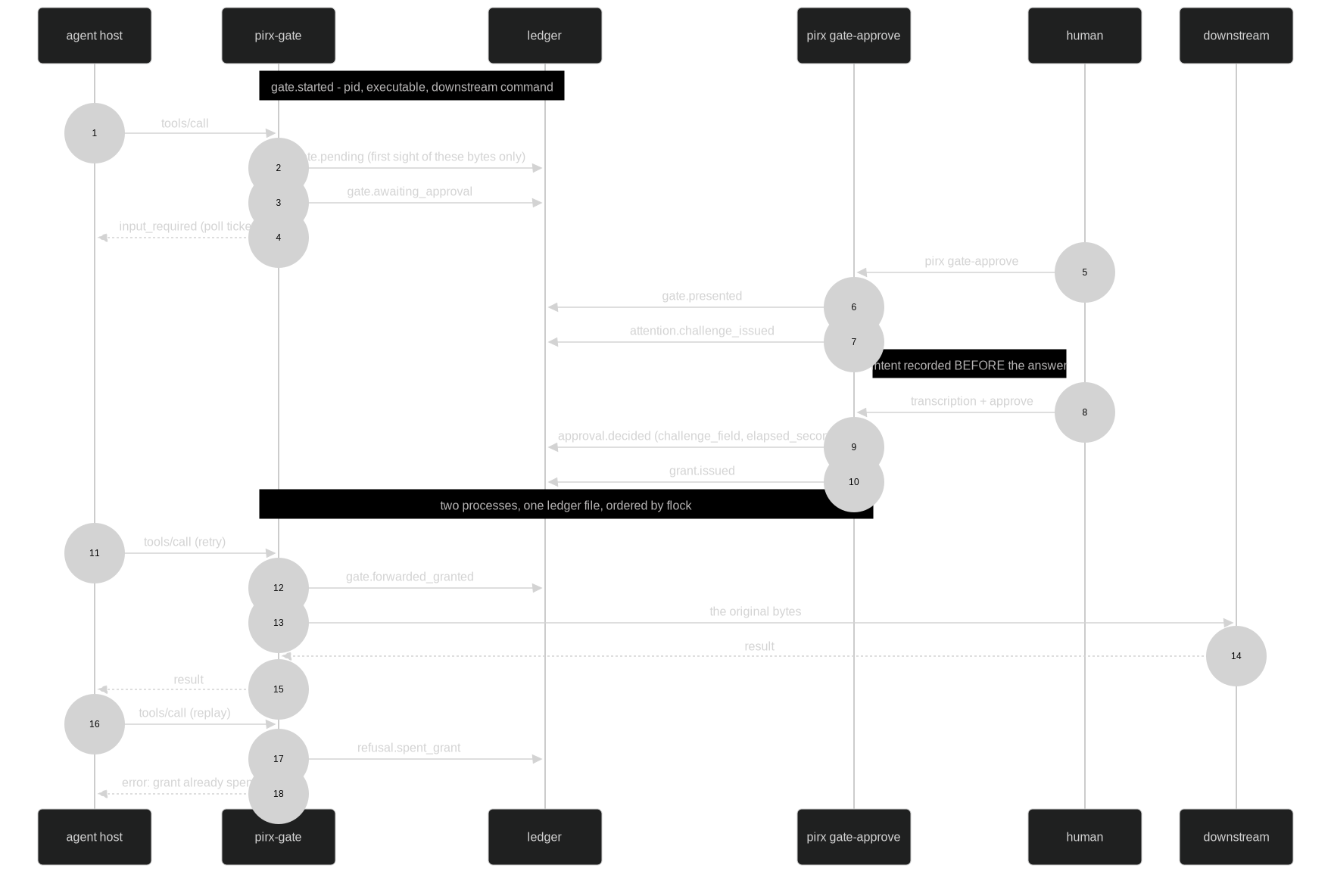
Mermaid source
%%{init: {'theme': 'dark'}}%%
sequenceDiagram
    autonumber
    participant A as agent host
    participant G as pirx-gate
    participant L as ledger
    participant AP as pirx gate-approve
    participant H as human
    participant D as downstream

    Note over G,L: gate.started - pid, executable, downstream command
    A->>G: tools/call
    G->>L: gate.pending (first sight of these bytes only)
    G->>L: gate.awaiting_approval
    G-->>A: input_required (poll ticket)
    H->>AP: pirx gate-approve
    AP->>L: gate.presented
    AP->>L: attention.challenge_issued
    Note right of AP: intent recorded BEFORE the answer
    H->>AP: transcription + approve
    AP->>L: approval.decided (challenge_field, elapsed_seconds)
    AP->>L: grant.issued
    Note over G,AP: two processes, one ledger file, ordered by flock
    A->>G: tools/call (retry)
    G->>L: gate.forwarded_granted
    G->>D: the original bytes
    D-->>G: result
    G-->>A: result
    A->>G: tools/call (replay)
    G->>L: refusal.spent_grant
    G-->>A: error: grant already spent
Two processes write this trail - the pump and each gate-approve walk - and
the order is the code's: the gate records gate.awaiting_ before it
answers, and gate.forwarded_ before it forwards, so an interrupted
forward leaves a record rather than silence.
8.4 Three habits worth forming
Absence is evidence. No grant.issued for a proposal means nothing was
authorised. An action that landed on a target with no grant event in any
ledger did not come through Pirx - which is how gate bypass becomes visible.
On the gate path the first sentence holds since 0.7.6.0; before it, a crash
between writing a grant and recording it could leave one spendable and
unrecorded (F65).
grant.spent followed by a refusal is normal and important. Authority is
consumed before the action runs, so a crash mid-action leaves a spent grant
and no result. Pirx will not retry: re-issuing is a human decision made with
the ledger in hand.
An open tail is information. A challenge_ with no successor means
someone was interrupted mid-approval. Intent precedes action here precisely so
that an interruption leaves a missing record rather than silence.
9. Directory lifecycle and pruning
Nothing in the gate directory expires on its own, and that is deliberate.
| Directory | Grows with | Safe to prune? |
|---|---|---|
pending/ |
every distinct gated call | Yes, once approved or abandoned. A pending file is a rendered proposal; deleting it loses the record of what was asked |
grants/ |
every approval | Yes, after the grant is spent or expired. An unspent, unexpired grant is live authority - deleting it cancels it. A hidden .HASH.json.tmp is an interrupted write that nothing reads; delete it |
spent/ |
every spent grant, forever | No. Each file is the durable proof that a nonce is burnt. Pruning is a replay window with a timer on it |
ledger.jsonl |
every event | No. Truncation is undetectable by design (§8.2) |
If spent/ size becomes a real problem, the answer is archival alongside the
ledger, not deletion: the two records are read together, and one without the
other answers half a question.
10. Recovery procedures
10.1 A run was interrupted mid-action
pirx reconcile my-ledger.jsonl
It asks the target system whether the write landed, using the idempotency key embedded in the action, and reports. It never re-executes. An automatic retry carrying authority across a crash is the privilege-persistence failure this design exists to refuse.
If reconciliation says the write did not land and you still want it: approve a new proposal. That is one more human decision, made with the full record in front of you, which is the correct price.
10.2 The gate's downstream server died
The pump exits 74 and records gate.downstream_. It does not restart
the child: a supervisor that silently respawned it would hide the crash the
ledger exists to show. Restart the gate yourself once you know why the server
died.
10.3 The ledger fails verification
refusal.ledger_ names the line and the sequence number where the chain
broke. Treat it as an incident, not a corruption to repair:
- A seam (
prev_mismatch) means a record was edited or replaced.hash - A sequence gap means a record was removed from the interior.
Do not "fix" the file. Preserve it, and reconstruct what happened from the target system and any off-host copy. A repaired ledger is a ledger nobody can rely on afterwards.
10.4 A grant is refused unexpectedly
Each refusal names exactly one cause.
| Refusal | Means |
|---|---|
refusal.grant_ |
the key changed, or the grant came from elsewhere |
refusal.hash_ |
the bytes changed after approval - most often a tool definition or an argument |
refusal.target_ |
the grant is for a different target |
refusal.expired_ |
more than five minutes passed between issue and spend |
refusal.grant_ |
the system clock moved backwards past the grant's issue time - a time-sync step or a manual change. Approve again; the grant was not spent |
refusal.spent_ |
a replay, or a retry after a crash that had already spent it |
11. Monitoring and alerting
The ledger is JSON lines and is designed to be shipped. Every event has a stable name; payload keys are stable within a name.
Alert on these:
| Event | Why |
|---|---|
refusal.grant_ |
someone presented a grant this gate did not issue |
refusal.grant_ |
the clock moved backwards across a live grant; find out whether time sync stepped or someone set it |
refusal.tool_ |
a downstream tool changed under a pinned hash |
refusal.header_ |
a peer's routing headers disagreed with its body |
refusal.ledger_ |
the audit trail itself failed verification |
gate.oversized_ |
a peer sent something past the frame bound |
Trend these, do not alert:
| Signal | What it tells you |
|---|---|
approval.decided.elapsed_ distribution |
approvals clustering just above the floor is the fatigue picture; the upper tail is noise |
refusal.challenge_ rate |
rising means approvers are answering without reading |
refusal.session_ |
the volume is beyond what one session should carry |
gate.forwarded_ vs gate.forwarded_ |
how much of your traffic the registry actually covers |
The alert nobody can write for you: an action appearing in your target
system with no corresponding gate.forwarded_ anywhere. Pirx cannot
detect that from inside, and it is the reason the ledger is worth shipping to
a place the gate's host cannot rewrite.
12. Reference: constants
Every limit that exists for a security reason is a constant in code. There is no configuration file, and adding one would be a rejected change.
| Constant | Value | What it bounds |
|---|---|---|
MAX_ |
2 000 | Producer or model text kept per field; the rest is truncated and recorded |
MAX_ |
10 | Proposals a single run will put in front of a human |
GRANT_ |
300.0 | Grant lifetime, from issue to spend, on the wall clock |
READING_ |
2.0 | Fixed part of the approval floor |
READING_ |
2.0 | Per-kilobyte part of the approval floor |
MAX_ |
20 | Grants one issuer produces before refusing |
MAX_ |
4 000 | Canonical argument JSON accepted from an intercepted call |
MIN_ |
32 | Shortest accepted grant key |
MAX_ |
1 000 000 | Longest JSON-RPC line the pump will read |
The reading floor for a proposal is 2.0 + 2.0 x (byte_
seconds. For an 892-byte proposal that is 3.742 s - checkable with a
calculator, which is the point.
Schema identifiers
| Id | Role |
|---|---|
cve-digest.verdict/ |
the verdict payload Pirx consumes |
pirx.proposal/ |
the canonical proposal rendering |
pirx.ledger/ |
the current ledger format (/ still readable) |
pirx.intercepted-call/ |
the justification produced from an MCP call |
2026-07-28 |
the only MCP protocol revision the gate accepts |
13. Reference: ledger events
| Event | Emitted when |
|---|---|
run.started |
a run begins; carries payload name, ledger schema, budget |
payload.accepted |
a verdict payload passed validation |
proposer.mode |
records whether a model was involved |
proposal.created |
a proposal was built from a justification |
proposal.rendered |
canonical bytes and an action hash exist |
prose.truncated |
producer or model text exceeded the bound |
review_ |
an item appeared in both the digest and the review lane |
attention.challenge_ |
the challenge was shown, before the answer |
approval.decided |
a human answered; carries attention evidence (the runner adds challenge_ and floor_, which gate-approve omits: F66) |
grant.issued |
a grant was issued; on the gate path it is written before the grant file (0.7.6.0), so a crash between them leaves this record and no authority, never the reverse |
grant.spent |
the nonce was burnt; carries the nonce alone |
capability.attempt |
the action is about to run |
capability.result |
the action returned |
capability.outcome_ |
the process died between attempt and result |
capability.outcome_ |
reconciliation established what happened |
run.finished |
the run ended; carries the exit code |
gate.started |
the pump came up; pid, executable, downstream command |
gate.pending |
a gated call was rendered and queued |
gate.awaiting_ |
a poll ticket was returned |
gate.presented |
a pending proposal was shown to a human |
gate.forwarded_ |
a call not in the gated registry passed through |
gate.forwarded_ |
a gated call was released under a spent grant |
gate.oversized_ |
a line past MAX_ was refused and drained |
gate.downstream_ |
the child closed its pipe |
gate.stopped |
the pump exited |
refusal.* |
see section 14 |
14. Reference: refusals
Every refusal is a typed event. None is a warning, and none lets execution continue.
Payload and parsing
| Event | Cause |
|---|---|
refusal.schema |
the payload's schema id is not one Pirx consumes |
refusal.bounds |
a field exceeded a hard bound |
refusal.malformed_ |
a CVE id did not match the anchored pattern |
refusal.enum |
a field carried a value outside its permitted set |
refusal.budget |
the run's proposal budget is exhausted |
Approval and attention
| Event | Cause | Usually means |
|---|---|---|
refusal.challenge_ |
transcription did not match | reading the wrong window, or not reading |
refusal.reading_ |
an approval arrived below the floor | a piped or reflexive answer |
refusal.session_ |
too many grants in one session | rotate the session |
refusal.declined |
a human said no | nothing is wrong |
Grants
| Event | Cause |
|---|---|
refusal.hash_ |
the grant does not cover these bytes |
refusal.target_ |
the grant is for another target |
refusal.expired_ |
the deadline passed before the spend |
refusal.grant_ |
the spend clock reads before the grant's issue time |
refusal.spent_ |
a replay: the nonce is already burnt |
refusal.grant_ |
not issued by a holder of this key |
refusal.malformed_ |
the grant file's shape is wrong |
The gate
| Event | Cause |
|---|---|
refusal.protocol |
the frame is not valid JSON-RPC |
refusal.protocol_ |
the peer speaks an MCP revision Pirx does not |
refusal.header_ |
a routing header disagreed with the body |
refusal.tool_ |
the definition changed since you pinned it |
Execution
| Event | Cause |
|---|---|
refusal.unregistered_ |
the action is not in the capability registry |
refusal.adapter_ |
registered, but nothing is wired to perform it |
refusal.model |
the model returned something out of contract |
refusal.ledger_ |
the ledger has a seam or a sequence gap |
One event you should never see
refusal.unspecified is the default on the base Refusal class and no
subclass uses it. If it appears in a ledger, a refusal type was added without
naming its event - a defect in Pirx, not a condition in your environment.
Report it with the surrounding records.
15. Reference: exit codes and environment
| Code | Meaning |
|---|---|
| 0 | the run completed; every proposal reached a decision |
| 2 | the payload was refused before any proposal existed |
| 3 | a refusal fired inside the loop |
| 64 | usage error |
| 74 | the gate's downstream server died |
| 78 | required configuration is absent |
| Variable | Read by | Effect if unset |
|---|---|---|
PIRX_ |
gate, gate-approve, runner |
Runner generates an ephemeral key; the gate refuses to start |
PIRX_ / _ / _ |
Jira adapter | The write refuses with refusal.adapter_ |
PIRX_ |
model client | The proposer is deterministic |
The test suite strips all of these, automatically. A suite that passes only in a clean shell reports the shell rather than the code.
16. Troubleshooting
command not found: pirx - you are in a different virtual environment.
The downstream server usually lives in its own venv; that is correct, and it
is not the one Pirx is installed into.
refusal.protocol_ on every call - the peer is speaking an older
MCP revision. Pirx accepts 2026-07-28 only, and most SDKs still default to
the 2025 era unless the new revision is opted into explicitly. This is a real
limitation, not a misconfiguration: supporting the older era would bring back
the initialize handshake and a protocol session, which is the ambient state
the design is glad to be rid of.
PIRX_ - the gate verifies grants
another process issued. The runner may generate an ephemeral key because it
approves and executes in one process; the gate may not.
The gate forwards everything and holds nothing - the gated registry is empty. That is the shipped state; see §4.4.
refusal.tool_ after upgrading a server - the definition
you pinned no longer matches. Re-derive the hash, read what changed, and
re-pin deliberately. This is the control working.
gate-approve exits immediately - the pending queue is empty, or every
pending proposal already has a grant. It walks the queue once by design.
An approval "hangs" - it is waiting for you to type. There is no timeout on the prompt, because a prompt that expires would train you to answer fast.
refusal.ledger_ in the gate directory - if the
seam sits at the first record gate-approve wrote, you are running a
checkout older than 0.7.3.0, where the pump and the approver both cached a
head hash and chained past each other (F59). Upgrade; existing ledgers keep
the seam, because a chain is not rewritable and pretending otherwise would be
worse than the break.
refusal.expired_ with an overdue_ near 1.8 billion, right
after upgrading - the grant was issued by 0.7.4.0 or earlier, whose
deadlines are seconds since boot rather than since 1970. Every such grant is
refused as expired, which is the safe direction: approve again.
refusal.malformed_ on every retry of one call - a file in
grants/ that does not parse as a grant. Since 0.7.6.0 the gate answers it
as an error and keeps serving; before, the pump exited with code 3 (F65).
gate-approve now writes grant files whole, so its own interruption cannot
leave one: the file came from an older version or from outside Pirx. It
never held a grant that could verify. Remove it and approve the call again -
the walk skips any proposal whose grant file exists, broken or not.
Tests fail with FileNotFoundError on a key path - you are running a
checkout older than 0.7.1.0. The suite has stripped Pirx's environment since.
17. What Pirx will not do
Load-bearing, not modesty. Each is a decision with reasoning in the threat model.
- It does not authenticate you.
approver_comes from the environment and is recorded withclaim authenticated: false. - It does not prevent gate bypass. An agent host that launches the downstream server directly never passes through the gate. Prevention lives in your environment - hold downstream credentials only in the gate's environment, and allowlist by process identity. What Pirx gives you is detectability.
- It does not measure comprehension. See §6.2.
- It is not a policy engine. No risk scoring, no rule language, no auto-approve threshold. A tool is gated or it is not.
- It does not do discovery, inventory, or payload inspection.
- It does not retry. Ever. See §10.1.
- It has no configurable security limits. See §12.
- It sends nothing back to the ranking system. Not at runtime, and not through development-time automation.
18. Glossary
Action hash - SHA-256 of the canonical rendered proposal. The identity of one fully-specified action.
Attention evidence - what the approval surface measured: which field was challenged, whether the answer matched, elapsed time, and the floor.
Canonical bytes - the one rendering of a proposal. Shown to the human, hashed for the grant, and never regenerated by a second code path.
Gated tool - an MCP tool registered in code, with the hash of the definition its reviewer read, whose calls the gate holds for approval.
Grant - authority bound to one action hash, single-use, expiring, MAC'd so another process can verify it.
Justification - why an action is warranted: a schema id, a reference, a digest over the source's own evidence, and any extra deterministic lines. Either a CVE verdict or an intercepted call.
Nonce - a grant's unique identifier, burnt in the spend store on use.
Poll ticket - the opaque identifier the gate returns while a call waits for a human. Carries no authority and no proposal content.
Reading floor - the minimum elapsed time before an approving answer is accepted, derived from the proposal's byte length.
Spend store - a directory with one file per burnt nonce, created with
O_ so two processes racing the same grant produce exactly one winner.
Untrusted prose fence - the labelled block around text written by a producer or a model. Escaped, bounded, and never a decision input.